What Is a PIC Microcontroller? Complete Beginner's Guide
Learn how PIC microcontrollers work, what's inside them, how they control electronic hardware, and how you can start programming and simulating PIC devices.
What Is a PIC Microcontroller?
A PIC microcontroller is an integrated circuit containing a processor, program memory, data memory, input/output pins, timers, and other peripherals required to control an electronic system.
Instead of building a circuit from a separate CPU, memory chips, timers, and digital interface logic, a microcontroller combines many of these functions into one package.
Consider a simple automatic light. A switch or sensor provides an input to the PIC. The PIC executes software that decides whether the light should turn on. An output pin then controls an LED or relay.
This basic input-processing-output pattern appears in almost every microcontroller-based embedded system.
PIC Microcontroller vs Microprocessor
A microcontroller and a microprocessor both contain a CPU, but they are normally designed for different types of systems.
A general-purpose microprocessor usually depends on external memory and additional support chips. It is commonly used in systems that run complex operating systems and applications.
A PIC microcontroller typically integrates the CPU, program memory, RAM, GPIO, timers, and several hardware peripherals on the same chip.
PIC Microcontroller
CPU, memory, GPIO, timers, and peripherals are integrated into a compact device designed for embedded control.
Microprocessor
Usually forms the processing core of a larger computer system with external memory and more complex hardware.
This integration makes microcontrollers practical for dedicated devices that must be inexpensive, compact, and power efficient.
What Is Inside a PIC Microcontroller?
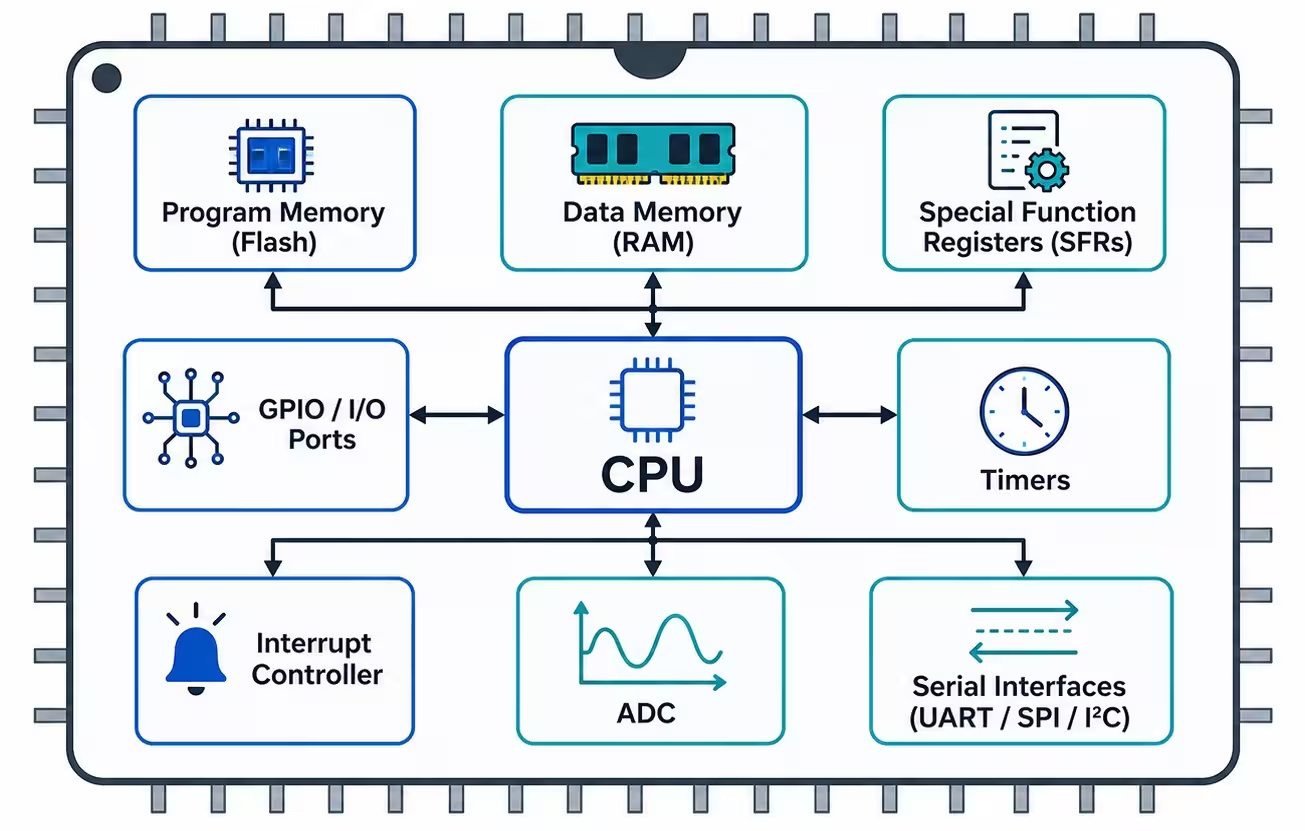
The exact features differ between PIC devices, but most PIC microcontrollers contain several common building blocks.
CPU
The CPU executes the instructions stored in program memory.
Instructions may move data, perform arithmetic, test individual bits, change program flow, call subroutines, or control hardware peripherals.
Program Memory
Program memory stores the firmware that the PIC executes.
In modern PIC microcontrollers, this is normally non-volatile Flash memory, which means the program remains stored even after power is removed.
RAM
RAM stores temporary data while the program is running.
For example, your program might use RAM locations for counters, measurements, intermediate calculations, flags, or system state.
Special Function Registers
PIC microcontrollers use special function registers, often abbreviated as SFRs, to control internal hardware.
A program can read or modify these registers to configure functions such as:
- GPIO direction
- timers
- interrupts
- serial communication
- analog inputs
- PWM outputs
Understanding registers is one of the most important skills when learning low-level PIC programming.
GPIO Pins
General-purpose input/output pins, or GPIO pins, connect the PIC to external electronics.
A GPIO pin may be configured as an input to read a button or sensor, or as an output to control an LED, transistor, relay, or other device.
Timers
Hardware timers can count internal clock cycles or external events.
They can be used for:
- generating accurate delays
- measuring time intervals
- counting external pulses
- generating periodic interrupts
- supporting PWM generation
Interrupt System
Interrupts allow the PIC to respond quickly to an event without constantly checking for it in the main program.
An interrupt might occur because:
- a timer overflowed
- an external signal changed
- a serial byte arrived
- an ADC conversion completed
When an interrupt occurs, the processor temporarily changes program flow to execute an interrupt service routine.
Communication Peripherals
Many PIC microcontrollers contain hardware for communicating with other devices.
Depending on the model, interfaces can include:
- UART or USART
- SPI
- I2C
- CAN
- USB
Analog Peripherals
Many PIC devices include analog hardware such as analog-to-digital converters, comparators, and voltage references.
An ADC allows the microcontroller to measure a changing voltage from a sensor and convert it into a numerical value that software can process.
How Does a PIC Microcontroller Work?
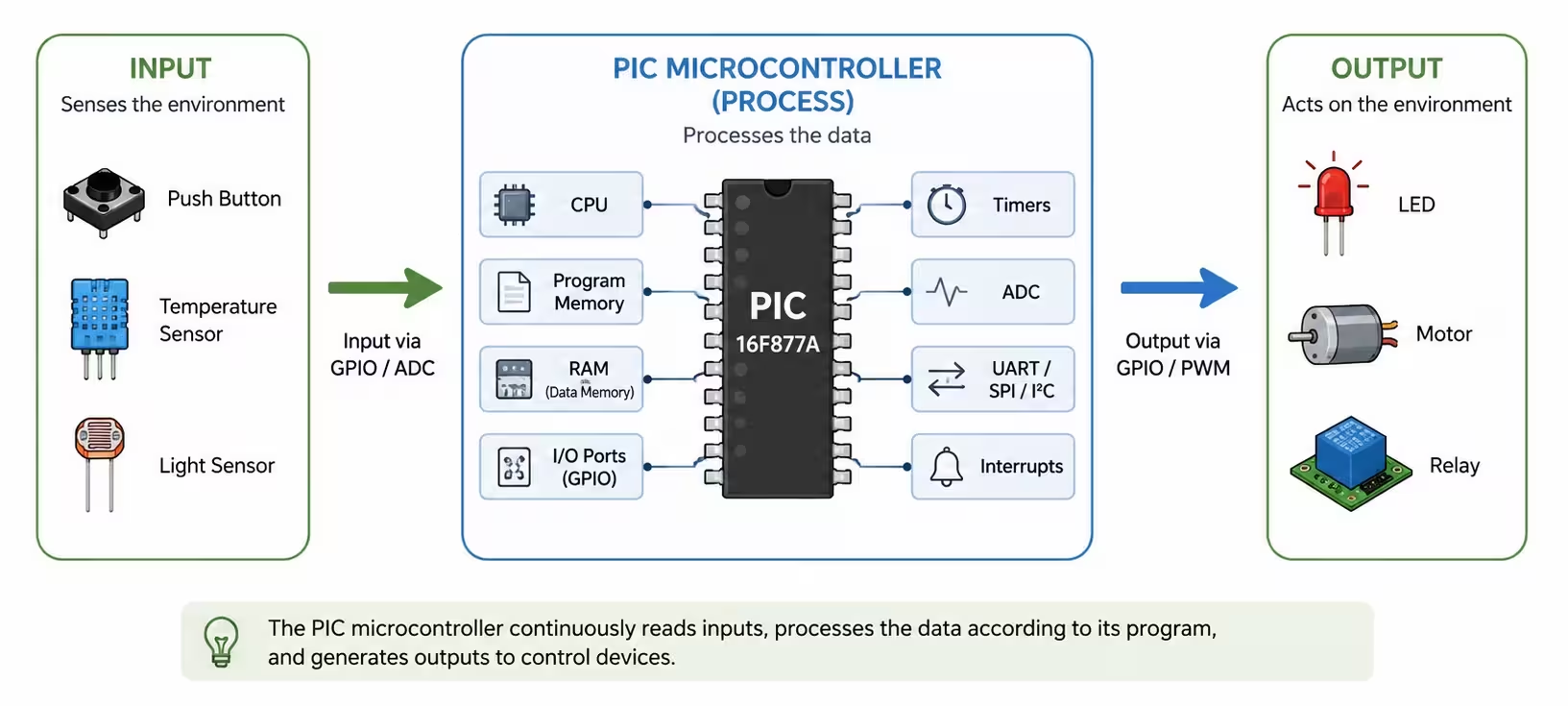
A PIC works by repeatedly fetching instructions from program memory, decoding them, and executing them.
A simplified execution cycle looks like this:
- Fetch an instruction from program memory.
- Decode the instruction.
- Execute the required operation.
- Update registers or memory if necessary.
- Move to the next instruction.
This process happens continuously while the microcontroller is running.
Program Counter
The program counter keeps track of the address of the instruction being executed.
Normally it advances through the program sequentially, but instructions such as GOTO, CALL, RETURN, and conditional skip instructions can change the execution path.
Working Register
Classic 8-bit PIC microcontrollers use a working register commonly called the W register.
It is used extensively when moving data and performing arithmetic or logic operations.
For example:
The MOVLW instruction places the value 0x05 into the W register. MOVWF then copies the value from W into the register or RAM location named counter.
Status Register
The STATUS register contains important processor flags.
For example, arithmetic operations may update flags that indicate whether a result is zero or whether a carry occurred.
Programs can use these flags to make decisions and change program flow.
PIC and Harvard Architecture
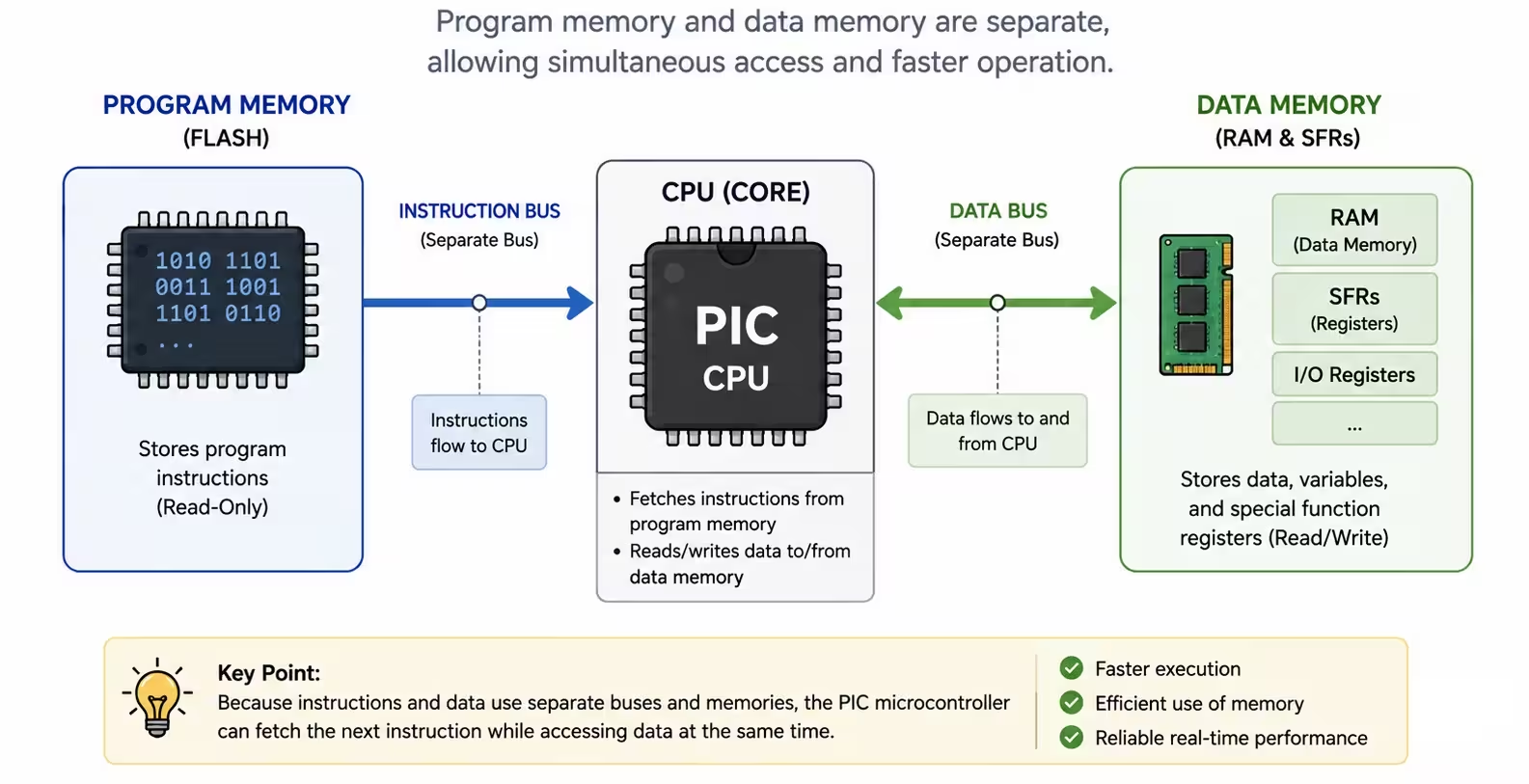
Many PIC microcontrollers use a Harvard-style architecture in which program memory and data memory are separate.
Program memory stores instructions, while data memory stores registers, variables, and temporary values.
This organization allows instruction storage and data storage to have different structures and can simplify efficient instruction execution.
Data Memory: Stores variables, registers, and temporary data.
PIC Microcontroller Families
PIC is not a single microcontroller. It is a large family of microcontrollers covering devices with different performance levels, memory capacities, peripherals, and package sizes.
PIC devices are commonly grouped into several broad families.
8-Bit PIC Microcontrollers
8-bit PIC devices are widely used for simple and moderately complex embedded-control tasks.
Well-known examples include:
- PIC16F84A
- PIC16F628A
- PIC16F877A
- many newer PIC16 and PIC18 devices
These devices are useful for applications involving GPIO, timers, interrupts, displays, serial communication, sensors, and control logic.
PIC16 Family
The PIC16 family contains many popular 8-bit devices and has long been used for teaching, hobby projects, and embedded products.
The PIC16F84A is particularly well known because its relatively simple architecture makes it useful for understanding low-level microcontroller programming.
PIC18 Family
PIC18 microcontrollers are also 8-bit devices but generally provide additional memory, peripherals, and architectural improvements compared with many older PIC16 devices.
16-Bit and 32-Bit Devices
Microchip also provides higher-performance microcontroller families for applications requiring more processing power, larger memory, advanced peripherals, or more sophisticated software.
The correct device depends on the requirements of the project rather than simply choosing the largest or fastest microcontroller available.
PIC16F84A as a Learning Microcontroller
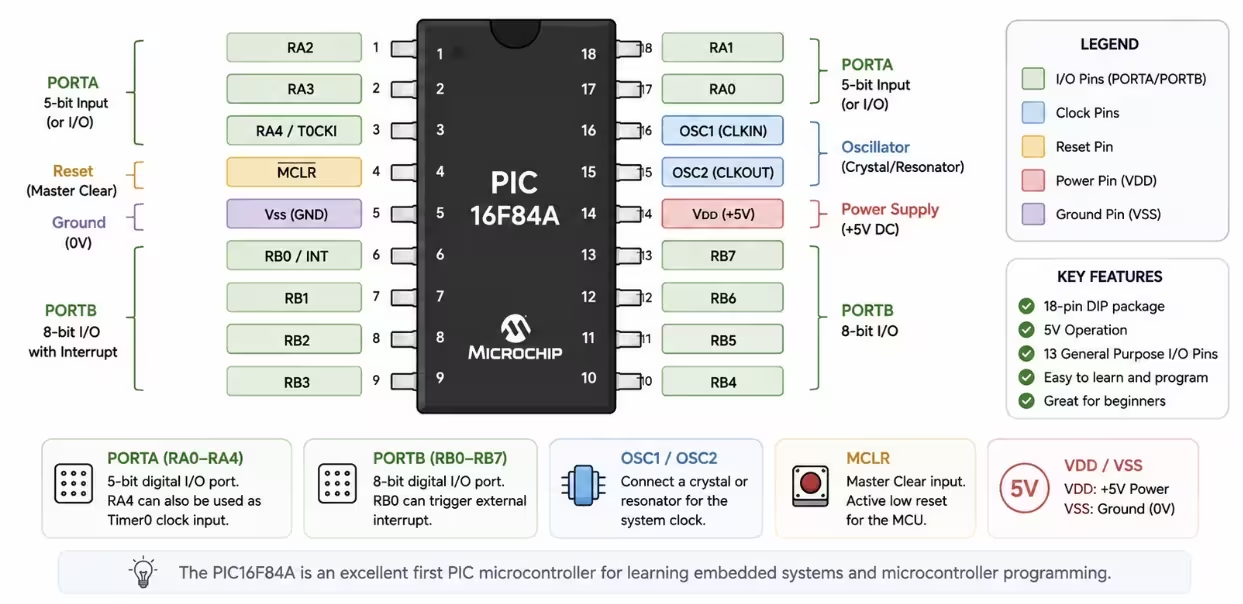
The PIC16F84A is one of the best-known classic PIC microcontrollers.
Although newer PIC devices provide significantly more peripherals and capabilities, the PIC16F84A remains useful for understanding fundamental concepts because its hardware is comparatively straightforward.
Topics that can be studied using the PIC16F84A include:
- assembly instructions
- the W register
- STATUS flags
- GPIO
- TRIS registers
- Timer0
- interrupts
- register banks
- program flow
- subroutines
PIC Simulator currently focuses on this style of PIC programming, making it possible to inspect many of these concepts interactively.
How PIC Microcontroller Pins Work
The pins around a PIC package connect the microcontroller to power, programming hardware, clocks, sensors, switches, displays, motors, and other external circuits.
A pin may have one or more possible functions depending on the microcontroller model.
Power Pins
Power pins provide the electrical supply required by the microcontroller.
They are commonly labeled VDD for the positive supply and VSS for ground.
GPIO Pins
GPIO pins can usually operate as digital inputs or digital outputs.
A direction register determines whether each pin is currently being used as an input or output.
Peripheral Pins
Some pins can be assigned to internal peripherals such as:
- UART transmit and receive
- SPI
- I2C
- PWM
- ADC inputs
- external interrupts
- timer inputs
This allows the same physical pin to perform different functions depending on how the microcontroller is configured.
How Is a PIC Microcontroller Programmed?
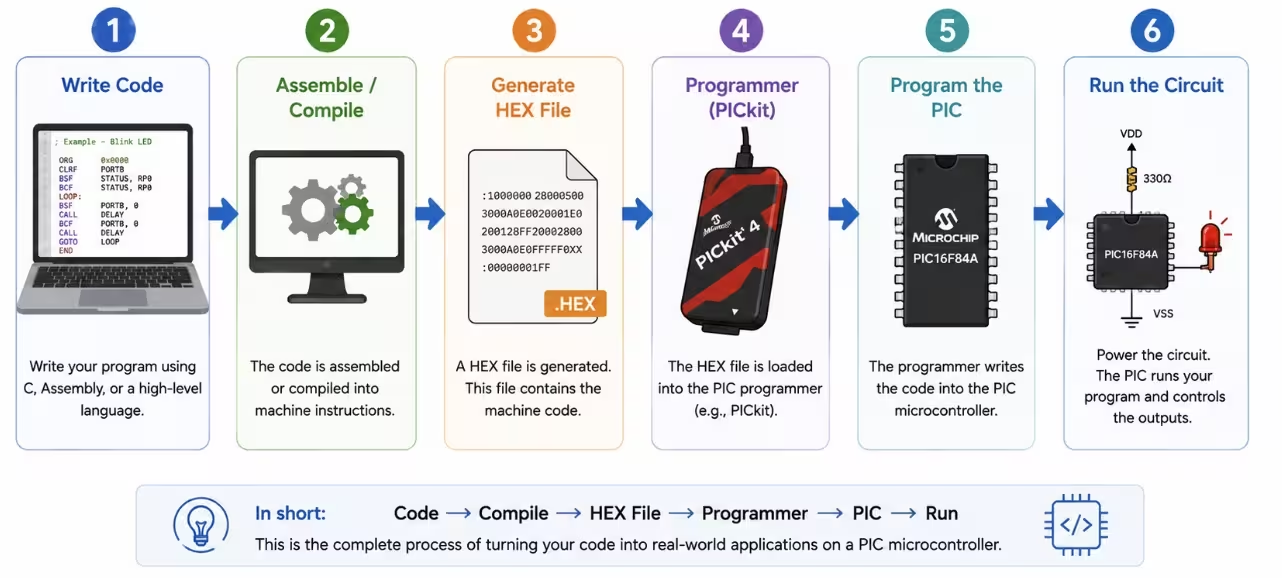
Programming a PIC normally involves writing firmware, compiling or assembling it into machine code, and transferring that code into the microcontroller's program memory.
A typical workflow is:
- Choose a PIC microcontroller.
- Write the firmware.
- Build or assemble the program.
- Fix any errors reported by the development tools.
- Connect a programmer or debugger to the PIC.
- Write the program into Flash memory.
- Run and test the circuit.
- Debug and modify the firmware as necessary.
PIC Assembly Language
Assembly language provides very direct control over the processor.
An assembly program consists largely of instructions that closely correspond to operations the CPU can perform.
This type of code exposes details such as registers, bits, banks, and individual CPU instructions.
For that reason, assembly language is particularly useful when learning how a microcontroller works internally.
C Programming
PIC microcontrollers can also be programmed in C.
C generally allows larger applications to be developed with less code than assembly while still providing access to registers and hardware peripherals.
In professional embedded development, C is commonly used for the majority of application code, while assembly may still be useful when working very close to the hardware or studying processor behavior.
Common PIC Assembly Instructions
Classic PIC assembly contains instructions for data movement, arithmetic, bit manipulation, testing, and program control.
MOVLW
Loads a literal value into the W register.
MOVWF
Copies the W register into a file register.
BSF
Sets an individual bit in a register.
BCF
Clears an individual bit in a register.
BTFSS
Tests a bit and skips the next instruction if the bit is set.
BTFSC
Tests a bit and skips the next instruction if the bit is clear.
DECFSZ
Decrements a register and skips the next instruction if the result becomes zero.
GOTO
Changes execution to another program address.
CALL
Calls a subroutine.
RETURN
Returns from a subroutine.
Learning how these instructions affect registers and program flow makes it much easier to understand what the processor is doing during program execution.
Simple PIC Microcontroller Program Example
One of the simplest embedded projects is blinking an LED connected to a GPIO pin.
Conceptually, the program performs the following operations:
- Configure the GPIO pin as an output.
- Turn the output on.
- Wait for a delay.
- Turn the output off.
- Wait again.
- Repeat continuously.
Even this very small application introduces several fundamental microcontroller concepts:
- GPIO configuration
- register manipulation
- loops
- timing
- binary output states
What Are PIC Microcontrollers Used For?
PIC microcontrollers can be found in many types of embedded electronics.
Example applications include:
- LED and lighting controllers
- digital displays
- temperature controllers
- motor controllers
- battery chargers
- power supplies
- sensor interfaces
- alarm systems
- electronic locks
- industrial control equipment
- measurement instruments
- appliances
- automotive electronics
- communication devices
The specific PIC chosen for a product depends on the required GPIO count, memory, speed, analog features, timers, communication interfaces, power consumption, package size, and cost.
PIC Microcontroller vs Arduino
PIC and Arduino are often compared by beginners, but they are not exactly the same type of thing.
A PIC is a family of microcontrollers. Arduino is primarily a development platform consisting of development boards, software libraries, an IDE, and an ecosystem designed to make embedded programming easier.
An Arduino board also contains a microcontroller. The difference is that Arduino provides a higher-level environment around the device.
PIC Microcontroller
Gives direct access to registers and hardware and is available in a wide variety of devices and packages.
Arduino
Provides development boards, libraries, and simplified software APIs that make it easier to begin building projects quickly.
Learning PIC assembly can provide a deeper view of how a microcontroller actually executes instructions and controls hardware.
Do You Need a PIC Programmer?
To place a program into a physical PIC microcontroller, you normally need compatible programming hardware.
A programmer connects the development computer to the programming pins of the PIC and transfers the compiled firmware into program memory.
Development tools may also support debugging features such as breakpoints, single stepping, register inspection, and memory viewing.
However, a physical programmer is not required when experimenting inside a software simulator.
Can You Simulate a PIC Microcontroller?
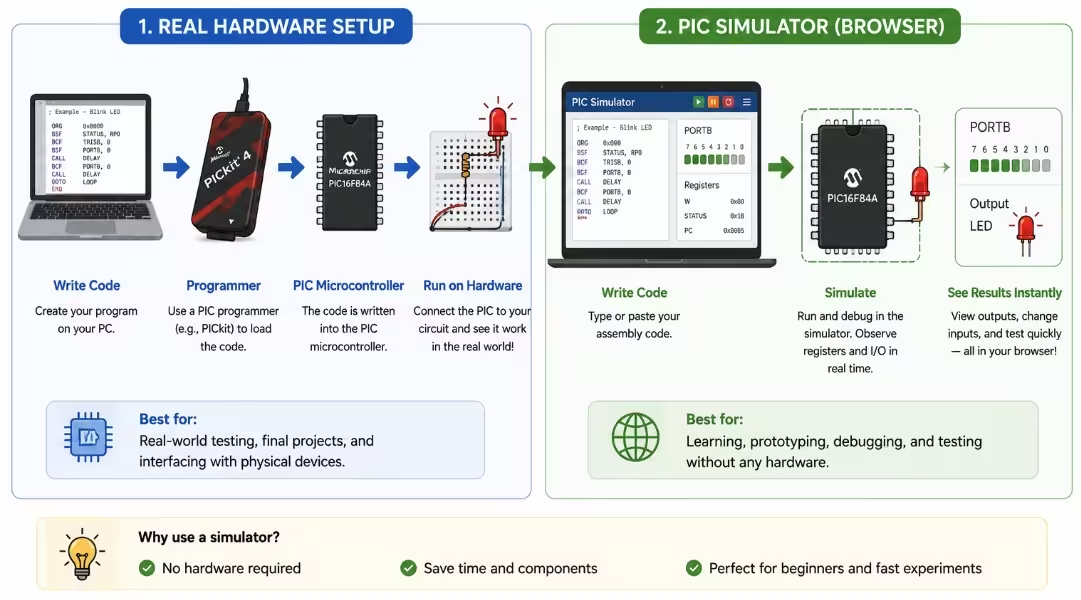
Yes. A simulator can model the operation of a PIC microcontroller in software so that you can test programs without first programming a physical device.
Simulation is particularly useful when learning because you can inspect internal processor state that would otherwise be difficult to observe.
PIC Simulator allows you to:
- write PIC assembly code in your browser
- assemble the program
- run the program continuously
- pause execution
- execute one instruction at a time
- set breakpoints
- inspect registers
- monitor memory
- control GPIO inputs
- observe simulated LEDs and displays
Why Learn PIC Microcontrollers?
PIC microcontrollers provide a useful platform for understanding the fundamentals of embedded systems.
Working close to the hardware exposes concepts that are sometimes hidden by higher-level development platforms.
These concepts include:
- CPU instructions
- registers
- binary and hexadecimal numbers
- memory organization
- GPIO
- timers
- interrupts
- instruction timing
- hardware peripherals
- embedded debugging
Once you understand these fundamentals, moving to other microcontroller families becomes easier because many embedded concepts remain the same even when the processor architecture changes.
How to Start Learning PIC Microcontrollers
If you are new to PIC programming, learning the concepts in a logical order can make the subject considerably easier.
A useful progression is:
- Learn binary and hexadecimal notation.
- Understand the basic PIC architecture.
- Learn the W register and file registers.
- Study a small set of assembly instructions.
- Configure a GPIO output.
- Blink an LED.
- Read a button input.
- Learn how loops and delays work.
- Use Timer0.
- Learn interrupts.
- Drive displays and other peripherals.
- Study serial communication.
You do not need to learn the entire instruction set before writing your first program. A small number of instructions is enough to begin experimenting with GPIO and basic program flow.
PIC Microcontroller FAQ
What does PIC mean in microcontroller?
PIC is the product-family name used by Microchip for a large range of microcontrollers. Today, it is best treated as the name of the microcontroller family rather than relying on a particular expansion of the letters.
Is PIC a microcontroller?
Yes. PIC refers to families of microcontrollers produced by Microchip Technology. Different PIC families provide different processor architectures, memory sizes, peripherals, and performance levels.
What is a PIC microcontroller used for?
PIC microcontrollers are used to control embedded electronic systems. Applications include sensors, displays, motors, appliances, industrial equipment, lighting systems, instruments, and communication devices.
Is PIC still useful for learning embedded systems?
Yes. PIC microcontrollers expose fundamental embedded concepts such as registers, GPIO, timers, interrupts, memory, and instruction execution. These concepts also apply to many other microcontroller architectures.
Can a PIC microcontroller be programmed in C?
Yes. PIC microcontrollers can be programmed in C using appropriate development tools and compilers. They can also be programmed in assembly language.
Can I learn PIC without buying hardware?
Yes. A PIC simulator lets you practice programming and inspect processor behavior without immediately purchasing a microcontroller, programmer, breadboard, or other hardware.
Which PIC is good for learning assembly?
Classic PIC16 devices such as the PIC16F84A are commonly used for introducing basic assembly concepts because their architecture and peripheral set are relatively straightforward.
Conclusion
A PIC microcontroller is a complete programmable control system contained inside a small integrated circuit.
It combines a CPU, program memory, RAM, registers, GPIO, timers, and other peripherals that allow software to interact directly with electronic hardware.
At its simplest, a PIC reads an input, executes instructions, and changes an output. The same principle can be expanded to build systems involving sensors, displays, motors, serial communication, interrupts, timers, and complex control algorithms.
Learning PIC programming is also a practical way to understand how embedded systems work at a low level because you can directly observe registers, instructions, memory, and hardware state.
If you want to begin experimenting without physical hardware, PIC Simulator lets you write, assemble, run, and debug PIC assembly programs directly in your browser.